
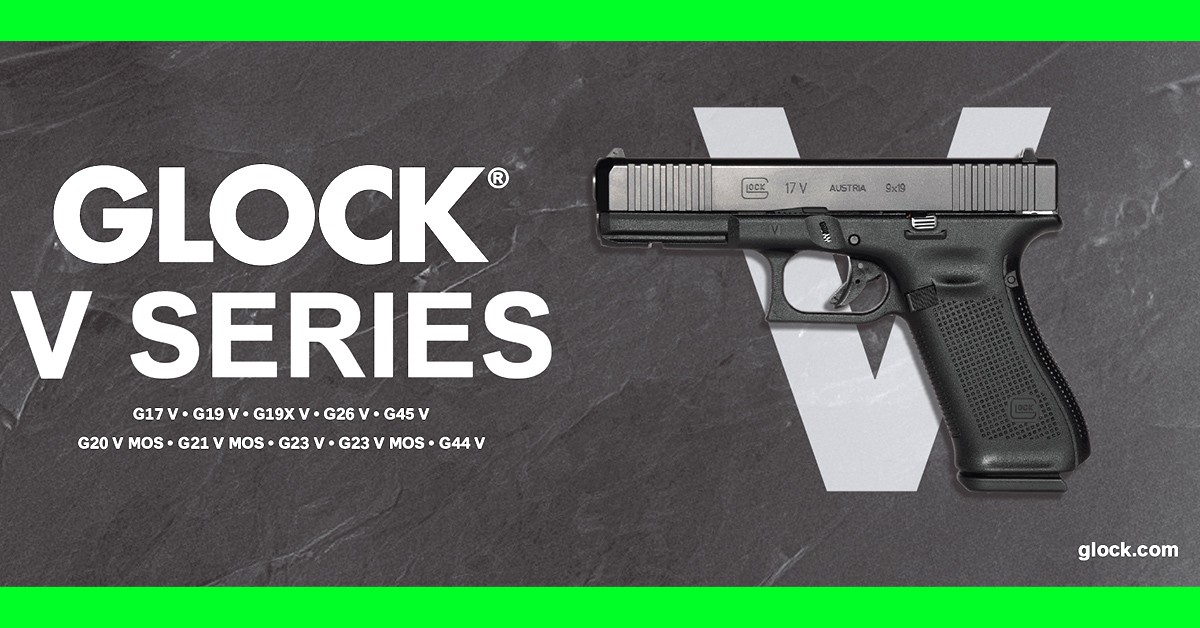
In late 2025, Glock quietly introduced one of the most significant changes in its modern history: the V Series. Marked with a distinctive “V” on both the slide and frame, these pistols are not a full new generation like Gen 5 was in 2015. Instead, they represent a refined, compliance-focused evolution of the Gen 5 platform.
The V Series was officially rolled out in December 2025 and is now the new baseline for most standard Glock models (G17V, G19V, G19XV, G45V, G26V, and several MOS variants). Glock has discontinued dozens of older models to streamline production. This article breaks down exactly what’s different, why Glock made these changes, and what it means for buyers, current owners, and the future of Glock pistols.
Why Glock Created the V Series
The primary driver behind the V Series is legal and regulatory pressure. Glock switches (auto-sears that convert a semi-automatic Glock into a machine gun) have become a major problem for law enforcement and the company. Several cities and states have filed lawsuits against Glock, claiming the company’s design made illegal conversions too easy.
Rather than wait for more lawsuits or potential bans, Glock engineered internal changes to make installing these illegal devices significantly more difficult. The V Series is essentially Glock’s proactive response: a “compliance-first” platform that maintains the trusted Gen 5 ergonomics and reliability while hardening the pistol against unauthorized modifications.
At the same time, Glock used this opportunity to simplify its product lineup, reduce SKUs, and create a cleaner, more consistent manufacturing process.
Key Differences: Gen 5 vs V Series
Externally, the V Series looks almost identical to a Gen 5 Glock. You’ll notice almost no difference at a glance.
What has changed internally:
- Slide Back Plate / Cover Plate The rear slide plate on V Series pistols has a slightly different shape and notch design. It is also marginally smaller. This change helps prevent certain aftermarket parts and illegal devices from fitting properly.
- Striker / Firing Pin Channel The most important change: Glock added raised ramps or “walls” on both sides of the striker channel inside the slide. The striker lug itself is narrower, and the channel it rides in is tighter. These modifications physically block the space where a Glock switch’s disconnector would normally engage.
- Trigger Housing / Trigger Mechanism Minor internal geometry changes to the trigger housing make it incompatible with certain Gen 5 aftermarket triggers and conversion parts.
- Other Minor Tweaks Slight changes to the extractor spring area and some internal tolerances for improved durability and consistency.
What stayed the same:
- Grip angle, texture, and ergonomics
- Overall dimensions and holster compatibility (most Gen 5 holsters still fit)
- Glock Marksman Barrel (GMB)
- MOS optics-ready system (on applicable models)
- Safe Action trigger system (still 3 internal safeties)
In short: The V Series is a Gen 5 with targeted internal modifications focused on anti-conversion hardening.
Parts Compatibility – What Actually Fits?
This is the biggest practical question for current Glock owners.
- Barrels: Gen 5 barrels generally work in V Series slides.
- Triggers: Many popular Gen 5 aftermarket triggers (especially those that modify the cruciform) do not drop in cleanly. Some require fitting; others simply won’t work.
- Slide Plates / Back Plates: Gen 5 plates usually do not fit the V Series.
- Recoil Springs: Minor differences exist, but most are interchangeable.
- Sights and Optics: Fully compatible.
If you’re a heavy customizer or run competition triggers, the V Series may require more work (or new parts) than a standard Gen 5.
Performance Impressions
Early reviews and range reports show the V Series performs almost identically to a Gen 5. The trigger feels very similar, reliability remains excellent, and accuracy is unchanged thanks to the same Marksman Barrel.
The changes are almost entirely “under the hood” for legal protection rather than performance enhancement. Most shooters report no noticeable difference in shooting feel or function.
What the V Series Means Going Forward
The V Series signals a major shift in Glock’s strategy:
- Streamlined Lineup Glock is retiring dozens of older models (Gen 4, some Gen 5 variants, etc.). The V Series becomes the new “standard” commercial pistol.
- Regulatory Defense By making illegal conversions harder, Glock is protecting itself from future lawsuits while maintaining the core design that made it famous.
- Future Generations Industry insiders believe the V Series serves as a bridge to an eventual Gen 6. The V platform provides a cleaner, more consistent base for future innovations.
- Availability and Pricing Because Glock is simplifying production, V Series pistols are expected to be more readily available and potentially priced more competitively than previous generations during the transition.
Should You Buy a V Series?
Yes, if:
- You want a brand-new Glock with the latest factory anti-conversion features.
- You mostly shoot stock or lightly modified pistols.
- You value long-term reliability and manufacturer support.
Maybe wait, if:
- You rely heavily on specific Gen 5 aftermarket triggers or parts.
- You prefer the absolute lowest price (Gen 5 pistols are being heavily discounted during the transition).
Final Thoughts
The Glock V Series is not a revolutionary new gun — it’s a smart, defensive evolution of the Gen 5 platform. Externally it’s the Glock you know and trust. Internally, it’s been quietly hardened against illegal modifications while maintaining the legendary reliability that made Glock the most popular handgun in America.
For most everyday carriers, law enforcement, and recreational shooters, the V Series represents a safe, future-proof choice. For competitive shooters and heavy customizers, it may require some adaptation.
The era of massive generational leaps (like Gen 4 to Gen 5) appears to be over. Glock is now playing a more calculated, long-game strategy — and the V Series is the first major step in that direction.


